
 English
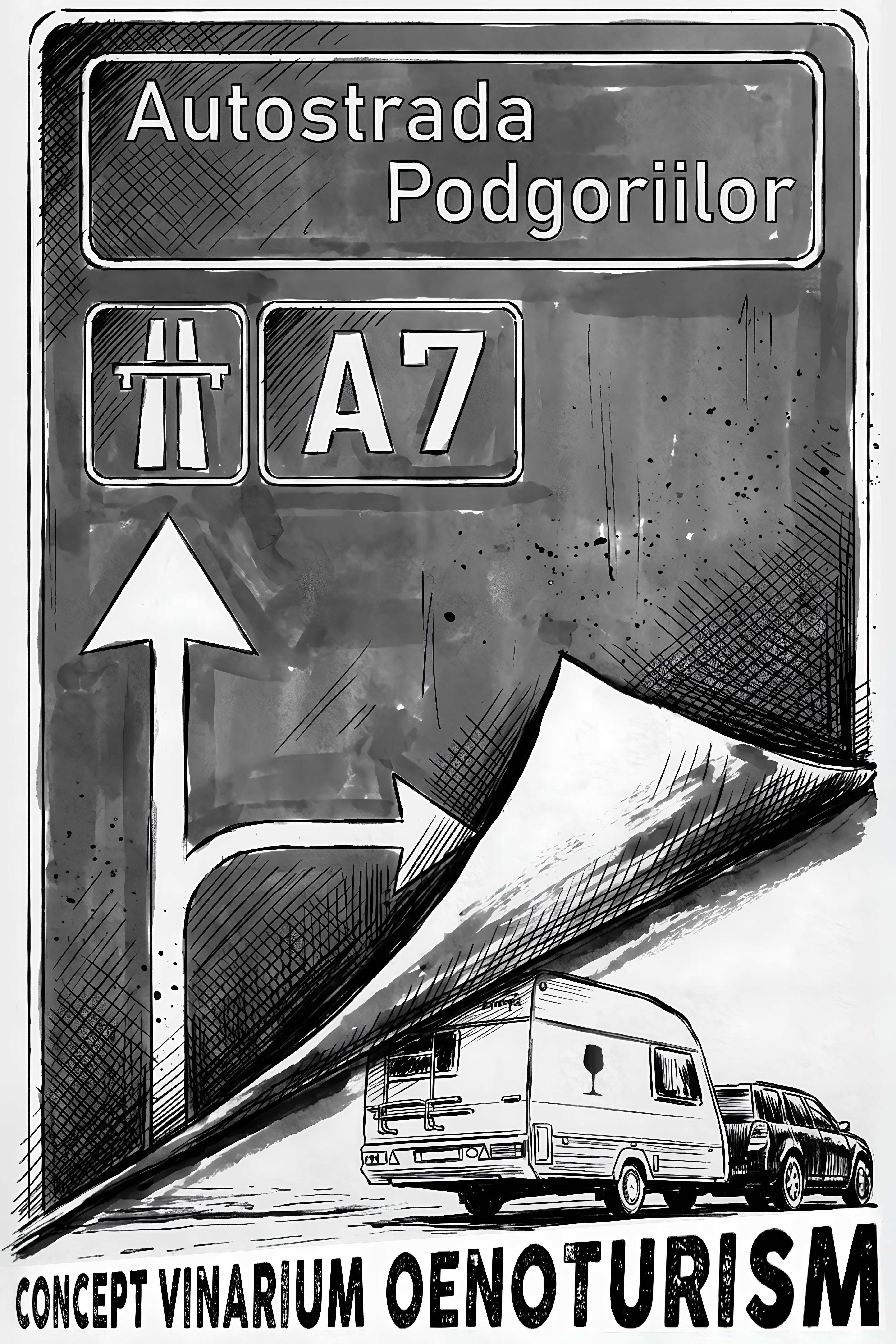
A7 – The Vineyard Highway / Autostrada Podgoriilor: A road to the collective good
There are rare moments in a country's history when infrastructure ceases to be just a technical entity – a series of kilometers, concrete, passages and road junctions – and becomes an instrument of cultural, social and economic reconstruction. Romania is now at such a moment.
The A7 highway, designed to connect Moldova with Wallachia, is more than a strategic road, it is a chance for identity repositioning, a route that touches communities, traditions, local economies and wine basins that define an entire vein of Romanian being.
That is why more and more specialists and cultural leaders are talking about the Vineyard Highway / Autostrada Podgoriilor. Not as a marketing name, but as a reality that expresses what A7 can – and must – be: a road to the collective good, a route of cohesion, a well-lit showcase of a new type of tourism and the backbone of a programmed development.
Because nothing better reflects the wealth, but also the subtlety of rural Romania than its vineyards, set like a living art gallery, from Cotnari, Iași, Strunga, Bucium, Bohotin, Averești, all of Vrancea, Dealu Mare of Buzău and Dealu Mare of Prahova.
Read more
A route with symbolic value: Santiago de Compostela, Via Transilvanica and the Vineyard Highway
The great cultural routes of the world have started, without exception, from infrastructure: a road, a path, a footpath. The Camino of Santiago is not only a direction for pilgrims, but also a key to the regeneration of dozens of Spanish communities. Via Transilvanica started as a soul project and became the Ariadne's thread of pedestrian and ethnocultural tourism in Romania.
Both examples show the same thing: a route becomes important when it reveals the stories of places and when it (re)connects the dissipated energies of a society.
The Vineyard Highway has the potential of such a route. It is, after all, a journey through culture. In a Europe where rural identity is fading, Romania still preserves the living chain of traditional activity, which can become an argument for mature tourism, for a healthy local economy and for a national brand, especially if modern viticulture and tourism are added... anticipatory in concept.
The road is not just asphalt. The road is the force that draws the past and the present closer to the future. And the future is worth looking at carefully.
From simple transportation to a new geopoetics* of Moldova
*The way in which geographical space becomes narrative / memory / culture.
The A7 represents more than just the transition from congested and anachronistic roads to a modern infrastructure; it represents the transition to a paradigm in which Moldova becomes truly connected – logistically, economically, and culturally. For the first time in decades, the region can overcome its isolation received as a “gift” from the central power.
And the vineyards, laid out like a series of natural museums, offer exactly what Europe is looking for today: authenticity, nature, gastronomy, living heritage. The Vineyard Highway is not just about the speed with which you arrive, but also the quality of the world you arrive in. Although it is a high-volume artery, the A7 will stimulate – paradoxically? – deep territorial tourism.
Motorhomes / campervans tourism – the opportunity Romania cannot afford to miss
Western Europe is dominated by a stable phenomenon: motorhomes / campervans tourism, caravanning and thematic routes. Spain, Portugal, Italy, France, Germany — all have developed in the last two decades an infrastructure dedicated to a new type of traveler, characterized by: autonomy, exploration of non-urban areas, constant consumption of local products and interest in culture and gastronomy.
The A7 is, geographically speaking, the only Romanian highway that can support such a flow: north-south, parallel to the mountains, crossing vineyards and rural spaces with natural attractiveness.
If the communities along the route were to install specialized, coherently marked rest areas, it could become, in five to seven years, a major caravanning hub in Eastern Europe. Vineyards that would do the same would gain visitors (buyers!), the communities would earn money, and the country brand would gain relevance.
The Vineyard Highway – more than a road axis: a cultural project
For the first time, Romania has the chance to create a concept that will differentiate it in Europe. If the A7 remains just a road, it will be useful – but not memorable. If however the A7 becomes the Vineyard Highway, then it will tell a story: the story of the oldest wine culture in this space.
A national brand is not built through slogans, but through intelligent infrastructures. The Vineyard Highway is, in itself, an act of culture.
Benefits for communities and the collective good
• Local economic growth – small producers can enter stable tourism circuits; large producers can play globally;
• Stopping depopulation – rural areas become attractive for investment and housing;
• Reverse migration – attracting the diaspora to an attractive living and business environment;
• Education and culture – thematic routes invite knowledge, not just consumption;
• Territorial coherence – Moldova becomes an integrated and visible region;
• National brand – Romania gains a unique landmark in Central and Eastern Europe.
A road that can change mentalities
Finally, the Vineyard Highway is an invitation to normality, to joy, to the balance that comes from doing good together. It is not only a technical project, but also an identity one. It is Romania's chance to transform infrastructure into culture, transportation into experience, mobility into prosperity.
A7 is a number.
The Vineyard Highway is meaning.
Occupational opportunities generated by the Vineyard Highway / Autostrada Podgoriilor
Such a large-scale infrastructure is not just about transit; it is about work ecosystems. From tourism services to modernized agriculture, from heritage restoration to logistical transport, the A7 creates dozens of professional ramifications. Rural areas can absorb new forms of labor: wine tourism guides, hospitality workers, camping center operators, artisans, technicians, sommeliers, quality inspectors, cultural event organizers.
In a region where emigration was the norm, the Vineyard Highway / Autostrada Podgoriilor can become the balance that brings people back, the only chance for demographic growth.
Business opportunities: a complete value chain
A7 – Vineyard Highway / Autostrada Podgoriilor activates the entire economic chain associated with wine and tourism:
• micro-wineries and artisanal wine projects;
• large wineries with a consistent display of quality;
• tasting spaces and rural catering;
• local retail with specific products;
• service areas for motorhomes / campervans;
• controlled and culturally integrated real estate developments;
• vocational training centers in viticulture and wine tourism;
• environmental ecology.
Last but not least, each locality along the route can develop its own economic cluster, linked either to wine, gastronomy, horticulture, crafts, art, sports or wellness. .
Entertainment: experiences that bring the road to life
The Vineyard Highway / Autostrada Podgoriilor is not just about visiting, it’s about experiencing. Along the new route, the following can be seen:
• food festivals;
• thematic flea markets;
• open-air concerts;
• biking and hiking trails;
• movie nights in unconventional spaces;
• events under a unique, cohesive, internationally recognizable brand.
Rural entertainment doesn’t mean noise; it means intelligently distributed energy that brings visitors and vitalizes communities. It means cultural ecology.
Folk art – the cultural DNA of the route
No thematic route is complete without vernacular artistic expression. Along the A7 - The Vineyard Highway / Autostrada Podgoriilor, the areas crossed can become laboratories of traditional art and once again become ramps of affirmation:
• ceramics (including the Cucuteni vein);
• woodworking;
• fabrics;
• traditional ornaments;
• stone carving.
Each locality can propose its own symbolic object, creating a recognizable cultural thread, just as the Camino of Santiago has the shell and the Via Transilvanica has carved milestones.
Cult art: camps, residencies, monumental sculpture
A thematic highway is also a linear museum.
Romania can integrate along the A7 – Vineyard Highway / Autostrada Podgoriilor:
• open-air sculpture camps;
• residencies for artists;
• monumental installations;
• rural galleries;
• cultural spaces created in former mansions, schools or industrial buildings.
Thus, the A7 can become a European artistic corridor, not just a utilitarian route.
Advantage for localities without a winemaking tradition
Not all localities on the route are vineyards – and this is precisely where the opportunity lies. Each locality can generate its own identity marker, whether it is:
• gastronomic,
• folkloric,
• sports,
• natural,
• historical,
• craft
• or even technological!
... and can sell wines from the entire winemaking route reached by the A7.
The key is integration into a unitary narrative: The Vineyard Highway / Autostrada Podgoriilor is the road of living heritage, not just of wine.
The profile of the camper tourist
The European camper tourist has extremely well-defined characteristics:
• average income above the EU average;
• interest in nature, culture and gastronomy;
• constant consumption of local products;
• travelling as a family or couple;
• staying for 1-3 days in the same area and many days on the entire route (up to months);
• high respect for the environment and non-invasive rules of behavior.
He is the ideal tourist for reactivating rural economies.
They don't need malls, but space, authenticity and minimal but well-organized infrastructure. They will appreciate hiking trails, bike paths or mountain bike routes (including those through plantations), tennis courts, golf or fishing ponds.
A7 ends: two major air hubs – Bucharest and Iași
A thematic route is all the more valuable when it is internationally connected.
The A7 has the unique advantage of starting and ending in two cities with relevant airports:
• Bucharest – Henri Coandă, Romania’s largest airport, gateway for European and international tourists;
• Iași – a rapidly developing airport, the second largest in the country, with an increased flow of tourists from the West and Romanians from the diaspora. A new gateway to the East.
This air transport facility transforms the A7 – Vineyard Highway / Autostrada Podgoriilor into not only a national but also a European corridor.
Major attractions along the route
Stânca-Costești
- Romania's second largest water reservoir after the Iron Gates on the Danube. Spectacular landscape, opportunities for water sports and ecotourism.Cotnari
- An emblematic name for the Romanian winemaking tradition. History, indigenous varieties, huge potential for wine tourism.Cucuteni
- One of the oldest Neolithic civilizations in Europe. Museums and archaeological sites can transform the area into a continental cultural landmark.